
Why Understanding Decomposition Matters
Have you ever wondered what happens to fallen leaves, discarded food, or dead trees in nature? Without decomposers, our planet would be buried under layers of waste, and essential nutrients would be locked away, making new life impossible. Combine below article with some fun creativity for kids for happy memories.

Yet many children (and even adults) rarely get a close-up look at the fascinating world of decay. The invisible work of fungi, bacteria, and insects remains a hidden but crucial part of our natural systems.
Quick Resource: Download our “What Are Decomposers?” Quick Guide (PDF)
Learning about decomposers helps kids:
- Understand nature’s recycling system
- Build respect for small creatures and fungi
- Discover how life and death are interconnected
- Appreciate the balance of ecosystems
The Ultimate Clean-Up Crew: Why Kids Need to Understand Decomposers
It’s completely natural for kids to instinctively go “ew!” when they flip over a rock and see a swarm of bugs, or spot a strange, fuzzy fungus growing on a dead log. But flipping that reaction from disgust to absolute fascination is one of the best things you can do for their scientific development.
Learning about decomposers shifts a child’s perspective. It teaches them that nothing in nature is wasted, and that the end of one life cycle is literally the fuel for the next.
When we teach kids about the science of decay, we help them:
- Demystify nature’s recycling system: They learn that soil doesn’t just “happen” it is actively manufactured by billions of tiny workers.
- Build empathy for the “creepy crawlies”: Beetles, worms, and fungi stop being gross and start being recognised as the essential heroes of the garden.
- Understand the circle of life: It provides a gentle, fascinating way to discuss how life and death are intimately interconnected.
- Grasp ecosystem balance: They quickly realise that without these tiny creatures, the world would be buried under mountains of dead leaves and fallen trees.
The Secret Science Behind Decomposition
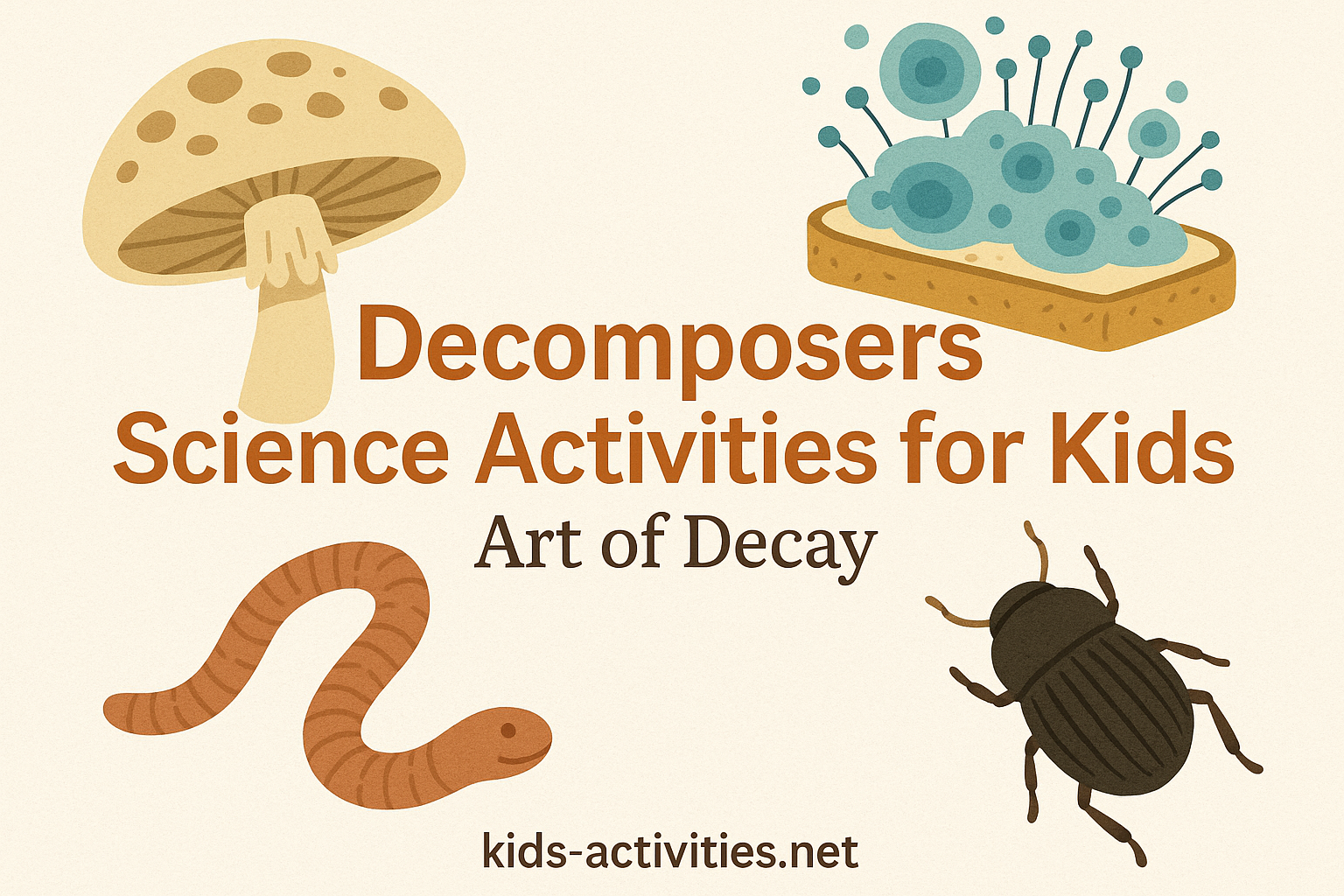
Decomposition isn’t just things rotting away; it is a highly coordinated, collaborative demolition project. It takes an entire army of organisms teaming up to break down tough organic material and turn it back into nutrient-rich soil.
Here are the main players in nature’s clean-up crew:
1. Fungi: The Heavy Lifters Fungi are the undisputed champions of the forest floor. While bacteria struggle with tough, woody materials, fungi produce specialized enzymes that can break down complex structural compounds like cellulose and lignin (the stuff that makes wood hard). Fun fact for kids: The mushrooms we see above ground are just the “fruit” of the fungus. The real work happens out of sight!
2. Bacteria: The Microscopic First Responders Bacteria are the invisible workforce that kicks off the entire softening process. They thrive in moist environments, quickly multiplying and attacking the easily digestible sugars and proteins in dead material. Fun fact for kids: There are more microorganisms in a single teaspoon of healthy soil than there are human beings on planet Earth.
3. Insects and Invertebrates: The Demolition Squad Before the microbes can do their best work, the big stuff needs to be chopped up. This is where insects like slaters (woodlice), millipedes, and beetles come in. They physically shred dead leaves and wood, creating a larger surface area for fungi and bacteria to attack. As they move around, they also carry fungal spores on their bodies, planting the “seeds” of decomposition wherever they go.
4. Earthworms: Nature’s Ploughs Charles Darwin was actually obsessed with earthworms, and for good reason. As earthworms eat their way through the soil, they digest decaying organic matter and excrete it as “castings.” These castings are essentially a biological super-fertilizer, packed with concentrated nutrients that plant roots can easily absorb.
Hands-On Activities: Exploring the Art of Rot
Free Activity Kit: Download our “Decomposition Science Activities for Kids” (PDF)
Here are two exciting activities that turn decomposition science into an unforgettable learning journey:
1. Fungal Networks: Visualising Mycelium with Mouldy Bread Maps

Materials:
- Several slices of white bread
- Plastic zip-lock bags
- Water spray bottle
- Permanent markers
- Observation sheet
- Magnifying glass (optional)
Instructions:
- Lightly spray bread slices with water.
- Seal each slice inside a labelled zip-lock bag.
- Store in a dark, warm place.
- Check daily for signs of mould growth.
- Use a permanent marker to map different colours and textures on the bag surface as mould appears.
- After a week or two, compare how different slices look. Which ones grew the largest “networks”?
Learning Points:
- Identify different types of fungi based on colour.
- Discuss how fungi spread through invisible threads.
- Understand environmental factors that influence growth.
2. Insect Digesters: Testing Decomposition Efficiency

The Backyard Bug Buffet: Testing Nature’s Tiny Garbage Disposals
If you really want to capture a child’s attention, tell them you are going to set up a bug buffet to see who can eat the most garbage. It sounds a bit gross, which is exactly why kids love it. But beneath the mess, this hands-on experiment teaches high-level biology, focusing on how different organic materials break down at completely different speeds.
We often tell kids that things like newspaper, apple cores, and dead leaves are “biodegradable.” But biodegradable doesn’t mean these things just magically disappear overnight. It takes a dedicated clean-up crew to physically chew, digest, and recycle them back into the earth.
The Fascinating Science of the “Bug” Gut Before you start, there is a brilliant scientific fact you can share with your kids: decomposition isn’t just about the insect’s jaws. When an insect eats a piece of organic waste, the real heroes are the microscopic bacteria living inside the insect’s gut (their microbiome). These bacteria produce special enzymes that dissolve tough plant fibres.
Interestingly, different insects have different gut bacteria. For example, mealworms (which aren’t actually worms at all, but the larvae of the Darkling beetle!) have incredibly efficient digestive systems. Scientists have even discovered that mealworms can safely eat and digest Styrofoam, though we will stick to organic waste for this experiment!
How to Set Up the Digestion Experiment
You don’t need a fancy laboratory for this just a few basic supplies and a trip to your garden or local pet shop.
What you need:
- The Clean-Up Crew: A tub of mealworms, some crickets, or a handful of compost beetles.
- The Habitats: Three small, clear plastic containers with air holes poked in the lids.
- The Menu: Three distinctly different types of organic waste. We recommend a fresh veggie scrap (like carrot peels), a dry natural item (like dead autumn leaves), and a processed organic item (like shredded newspaper).
- The Tools: A digital kitchen scale and a notebook.
The Method:
- The Weigh-In: This is where the maths comes in. Have your kids weigh out exactly 10 grams (or any equal weight) of each material. Place the carrot peels in container one, the leaves in container two, and the newspaper in container three.
- Add the Crew: Add an equal number of insects to each container.
- The Observation Phase: Leave the containers in a dark, quiet, room-temperature spot. Have the kids check on them every day for a week, noting down any visible changes. Are the insects swarming one food but ignoring another? Is the wet food starting to soften?
- The Final Weigh-In: After exactly seven days, carefully remove the insects and weigh the remaining organic material.
What Kids Actually Learn from the Results
When the week is up, the results are usually pretty dramatic. The kids will quickly see that the carrot peels have drastically reduced in weight, the leaves have been nibbled, and the newspaper has barely been touched.
This leads perfectly into the core learning points of the experiment:
- Not all “biodegradable” waste is equal: Kids learn the difference between simple, water-rich sugars (the carrot) which are easy to digest, and tough, rigid cellulose (the newspaper), which takes a long time to break down.
- Specialised diets: They discover that biological recycling relies heavily on the species doing the eating. An insect might be brilliant at shredding a dead leaf, but completely ignore a piece of paper.
- The reality of landfill: This experiment visually proves why throwing organic waste into a plastic garbage bag (where insects and oxygen can’t reach it) stops the recycling process dead in its tracks. It is a fantastic, hands-on introduction to why we compost!
Extra Exploration

Want even more ways to discover decomposition without too much extra setup? Try these:
Compost Temperature Tracker
- Insert a simple soil thermometer into an active compost pile.
- Record temperatures morning and evening for a week.
- Graph results to observe microbial heat generation patterns.
Bioluminescence Hunt
- Research bioluminescent fungi (like Armillaria mellea).
- If possible, carefully observe forest logs at night to spot natural glow.
- If not available, watch online videos together and discuss!
Next-Level Concepts to Share with Kids
If you want to blow a kid’s mind, you don’t need to look at outer space just look at the dirt. Here are three incredible scientific concepts that drive decomposition:
- The “Wood Wide Web” (Fungal Networks): Beneath the soil, fungi create vast, sprawling webs of tiny white threads called mycelium. These networks actually plug into the roots of trees and plants. They act like an underground internet, allowing plants to share nutrients, water, and even send chemical warning signals to each other if pests are attacking.
- Microbial Succession (The Shift Workers): Decomposition happens in stages, almost like shift work at a factory. The bacteria that start the rotting process aren’t the same ones that finish it. As the environment changes and as different nutrients are eaten up—new crews of microbes move in to take over the next phase of the breakdown.
- The Power of Heat and Moisture: Decomposition is hard work, and the bacteria doing it actually generate body heat! If you stick your hand near the center of a healthy compost bin, it will feel hot. This process speeds up dramatically with warmth and water, but if an environment is too dry or freezing cold, the decomposers go dormant, hitting the pause button on the whole system.
Downloadable Resources
Mould Map Observation Sheet (PDF)
Insect Digestion Chart Template (PDF)
Compost Temperature Log (PDF)