
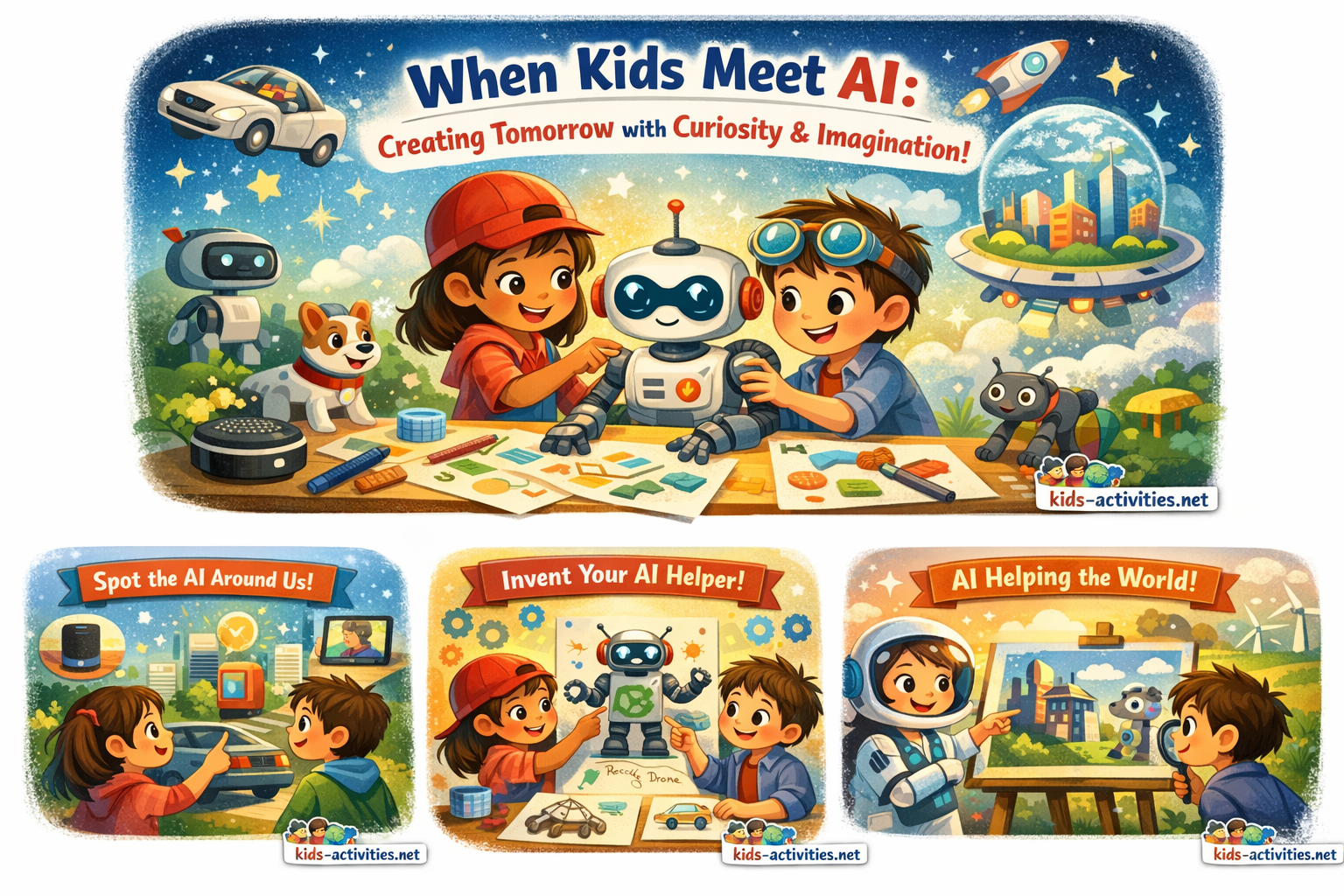
Are you looking for an educational activity that sparks imagination, introduces new technology, and encourages kids to become creators—not just consumers? Welcome to the playful world of Kids + AI Exploration! In this activity, children learn what Artificial Intelligence (AI) is, experiment with simple AI tools, and dream up inventions that could shape our future—robots that clean oceans, apps that help endangered animals, or smart homes made for plants!
This theme is ideal for ages 6–12, flexible for classrooms, homeschooling, after-school programs, or weekend family projects. These activities will walk you through everything you need to know: how to introduce AI to kids in simple terms, creative activities you can do, learning outcomes, and playful variations that make AI feel exciting—not intimidating.
Why AI Exploration Matters for Kids
Learning about AI isn’t just for engineers and tech companies—it’s becoming part of everyday life, from smart speakers to online maps to language translation. When kids explore AI through creative play, they:
Build problem-solving skills
They learn that technology is made by humans—and that they can make it better.
Boost creativity
AI becomes a tool to extend imagination rather than replace it.
Strengthen literacy and communication
Kids explain ideas, describe inventions, and tell stories.
Develop future-ready confidence
Instead of fearing change, kids learn how to shape it.
Most importantly: AI exploration is not about screens only—it’s about ideas, invention, and imagination.
What Exactly Is AI — Explained Kid-Style
Kids don’t need complex definitions. Here’s a simple way to explain AI:
“AI is like a clever helper that learns from information. We tell it what we want, and it tries to help us—like a robot brain that learns patterns!”
Then you can give everyday kid-friendly examples:
- When YouTube suggests videos → AI guessed what you like
- When Google Maps shows the fastest road → AI learned how cars move
- When a robot vacuum avoids bumps → AI learned how to navigate
Now AI feels less scary and more like a friendly helper.
What You’ll Need (Materials Checklist)
Just like your Nature Portrait example, we keep it simple and accessible!
Basic materials:
- Drawing paper or sketchbooks
- Pencils, crayons, or markers
- Sticky notes
- Large poster paper (for group activities)
Optional materials:
- Tablet or computer (for simple AI demos or drawing tools)
- Recycled cardboard (for prototyping)
- LEGO or building blocks (for AI invention models)
Important note:
Kids do not need to code. We focus on creativity + understanding.
How to Explore Kids + AI: Step-by-Step Activities
Here’s a structured session that mixes hands-on creativity with technology awareness:
Warm-Up: Spot the AI
Start with a fun question:
“Where have you seen smart helpers today?”
Kids might shout out:
- phones
- cars
- Alexa
- robots
- YouTube
- Google search
You can make a chart:
- AI at Home
- AI at School
- AI in Games
- AI in Nature
This builds awareness and vocabulary.
Learn Through Storytelling
Tell a short imaginative story about AI—example:
“In the year 2050, Mia has a homework buddy robot named Pixel. Pixel helps kids learn math and builds science experiments. But one day, Pixel needs help—his robot plant won’t grow! Mia must solve the mystery…”
Then ask:
- “What did AI help with in the story?”
- “What problems did the kids help solve?”
This teaches that AI supports humans, not replaces them.
Imagine a Better World
Now we switch into design mode.
Ask:
“What is one problem in the world you’d love to fix?”
Kids might say:
- Trash in oceans
- Animals going extinct
- Too much homework
- Cars getting stuck in traffic
- Sick people needing help
Write answers on sticky notes—this primes innovation thinking.
Create Your AI Helper
Now kids design an AI invention inspired by their chosen problem.
They draw and label:
- Name of invention
- What problem it solves
- How AI helps
- Who would use it
Examples kids often come up with:
- TrashBot 5000 → AI robot that sorts recycling
- Homework Hero → AI teacher that explains hard concepts
- VetAI → AI scanner that checks animal health
- SkyTraffic AI → Drones that guide cars to avoid traffic
- PlantFriend → Smart greenhouse that talks to plants
This is the heart of the activity—kids become inventors.
(Optional) Try a Simple AI Tool
If you have a tablet/computer, try 1–2 simple kid-safe tools:
AI Drawing — kids describe images, AI generates them
Voice recognition — kids talk, AI responds
Translation — kids say phrases in different languages
Remind them:
“AI is learning from our instructions. We are the teachers!”
This frames them as creators, not passive users.
Share & Celebrate
Finally, do presentations!
Kids introduce:
- their invention,
- the problem it solves,
- why it matters for the future.
This builds public speaking + empathy + agency.
Educational Benefits of AI Exploration
This activity is loaded with cross-curricular learning:
STEM / Science
- Systems, invention, sensors, machines
Language Arts
- Storytelling
- Explanation
- Vocabulary
Math
- Problem analysis
- Patterns and data ideas
Social Studies
- Real-world issues
- Future societies
- Ethics and responsibility
Soft Skills
- Leadership
- Creativity
- Communication
- Teamwork
By the end, kids understand that AI is a tool humans design—not magic and not scary.
Creative Variations to Keep Things Fresh
Want new twists? Try these:
Art + AI Gallery
Kids draw future cities and label where AI lives:
- smart trees
- flying buses
- AI weather towers
- robot museums
Hang them as a class gallery!
AI Role-Play Game
Kids pretend to be:
- “AI robots”
- “programmers”
- “inventors”
- “users”
They act out:
- How AI learns
- How errors happen
- How humans fix them
This teaches that AI is not perfect and humans guide it.
LEGO + AI Builders
Kids create robot inventions using:
- LEGOs
- cardboard
- recyclables
Then explain the AI logic verbally:
“When the ocean is dirty, my robot turns on.”
This teaches if–then thinking without code.
Future Story Writing
Kids write short stories like:
- “A Day with My Robot Cat”
- “School in 2075”
- “The AI Detective Agency”
This links technology with literacy and imagination.
Tips for Parents & Educators
To make this experience meaningful:
1. Use Kid-Friendly Language
Avoid jargon like “machine learning” or “computational models.”
Use phrases like:
- “It learns from patterns.”
- “It guesses what we want.”
- “We teach it with examples.”
2. Encourage Ethical Thinking
Ask:
- “Should we use AI here?”
- “Who does it help?”
- “Could it cause problems?”
Kids are surprisingly thoughtful!
3. Avoid “AI will take your job” Narratives
Instead say:
“AI helps humans. Humans decide how to use it.”
4. Celebrate Imperfection
If AI makes weird outputs, say:
“AI is learning! Sometimes it gets confused.”
This reduces fear and raises curiosity.
How AI Is Already Changing Kids’ World (Gently Explained)
Kids today will grow up with:
- AI doctors that scan illnesses earlier
- AI tutors that personalize lessons
- AI climate tools that predict storms
- AI farms that protect crops
- AI smart homes that save energy
The important lesson is:
“AI helps humans solve big, real problems—but humans choose the goals.”
This teaches responsibility and empowerment.
The Future Belongs to Creators, Not Consumers
When kids explore AI this way, we plant mindset seeds:
✔ Curiosity: How does it work?
✔ Courage: I can learn and try.
✔ Compassion: How can I help people?
✔ Creativity: What can I build?
Kids don’t need to code to be inventors. Invention begins with imagination.
Activity Reflection: What Kids Learn About AI
After the session, ask kids:
- “What surprised you about AI?”
- “What invention are you most proud of?”
- “What problem do you care about solving?”
- “What would your AI need to learn to help?”
This turns exploration into thinking, not just drawing.
Final Thoughts: A Future They Can Help Build
Kids + AI is not about being “more digital.”
It’s about learning how the world works and imagining how it could be better.
Just like your Nature Portraits connected:
🌿 nature + art + mindfulness,
this experience connects:
technology + creativity + purpose.
With just simple tools—and a lot of imagination—children can step into the role of future inventors, engineers, storytellers, and leaders.
Next time your child says,
“I have an idea!”
ask them:
“What problem does it solve, and how could AI help?”
You might be surprised by the brilliance that follows.
Here’s to raising creators of tomorrow.