
Kids love YouTube — and let’s be honest, it’s not hard to see why. It’s colorful, funny, fast, and absolutely stuffed with content about everything from Minecraft to volcanoes to cooking shows. For parents, however, there’s a familiar worry: Is my child learning anything, or are they just watching endlessly?
The good news: We don’t have to choose between banning screens and surrendering to them. With the right approach, we can turn passive screen time into hands-on world exploration, STEM learning, creativity, and curiosity-driven projects.
This blog gives you ready-to-use activities that take inspiration from YouTube videos and convert them into real-world experiences, perfect for family time, homeschooling, after-school clubs, and classrooms.
WHAT IS THIS ACTIVITY ABOUT?
This blog introduces a three-part activity model that kids can repeat over and over:
Watch → Think → Do
Kids first watch a short YouTube video on a topic they love (animals, cooking, art, space, etc.), then reflect, and finally make or do something in the real world.
The goal is not to stop them from watching — it’s to link screen time to actual learning and action.
WHY IT WORKS
Kids learn best when they can:
follow their interests
explore with hands-on materials
talk about what they observed
create something physical or visual
YouTube provides the input. Real activities provide the output.
When combined, the result is:
- deeper comprehension
- sustained curiosity
- connection to the real world
- reduced mindless scrolling
ACTIVITY PACK
Below are five repeatable hands-on activities that explore world knowledge and science topics inspired by YouTube. They are designed to fit into categories like:
Kids World
Kids Science
Kids Education
Kids Craft
Each activity follows the same structured format as your existing content.
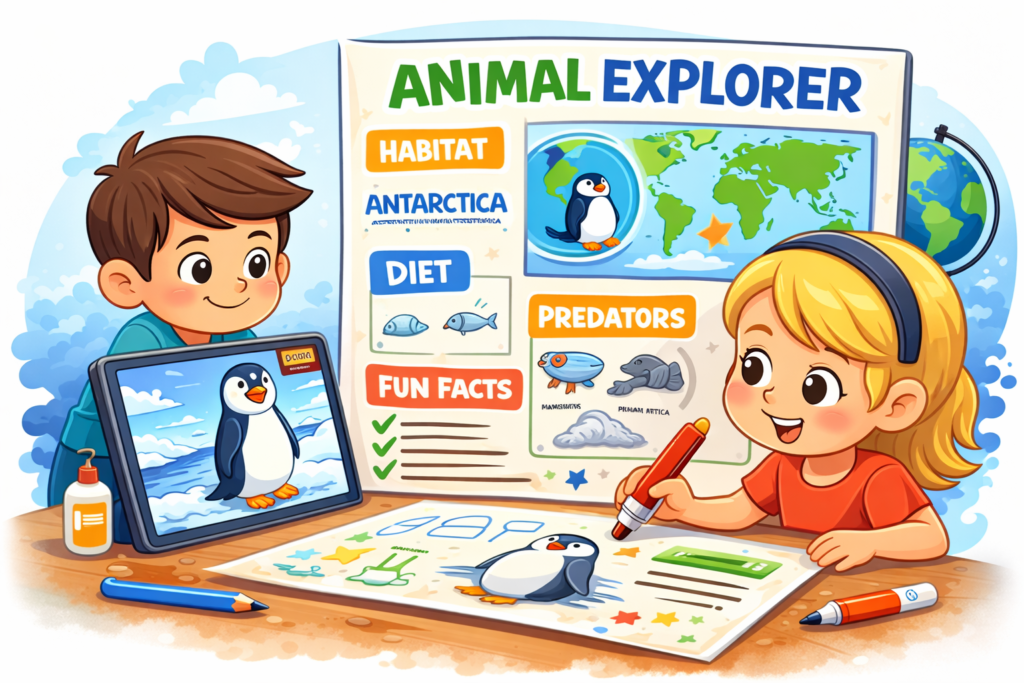
ACTIVITY 1: Animal Explorer Poster
(Inspired by wildlife & documentary YouTube videos)
Recommended Video Themes
- Penguins
- Rainforest animals
- Savannah animals
- Ocean creatures
Age Range
6–12 years
Time Needed
30–60 minutes
Difficulty
Easy
Materials
- Cardboard or poster paper
- Markers or crayons
- Printed pictures (optional)
- A ruler
- Glue & scissors
- Access to a wildlife video (Nat Geo Kids, BBC Earth Kids, etc.)
Instructions
- Watch a short animal video about a creature your child chooses.
- After watching, ask your child to name five things they learned (e.g. habitat, food, predators, interesting facts).
- On the poster, draw or paste a picture of the animal.
- Create labeled sections:
- Habitat
- Diet
- Predators
- Fun Facts
- Location on a Map
- Add color and decorate the poster.
- Present the poster to a parent, teacher, or sibling.
Learning Benefits
Geography & ecosystems
Critical observation
Research & summarizing skills
Public speaking confidence
Fine motor & layout design
Extensions
ACTIVITY 2: DIY Volcano Science Lab
(Inspired by earth science videos)
Recommended Video Themes
- Volcanoes
- Plate tectonics
- Lava flows
- Earth layers
Age Range
6–12 years
Time Needed
45–90 minutes
Difficulty
Medium
Materials
- Baking soda
- Vinegar
- Dish soap (optional)
- Red food coloring (optional)
- Plastic cup
- Playdough or dirt + water paste
- Tray to contain mess
- Safety goggles (optional but fun!)
Instructions
- Watch a volcano explanation video (SciShow Kids or Crash Course Kids).
- Discuss why volcanoes erupt and what happens below Earth’s surface.
- Build a volcano around a plastic cup using dirt or playdough.
- Fill the cup with baking soda + dish soap.
- Add a few drops of food coloring.
- Pour vinegar in and watch the eruption.
- Repeat with different amounts to compare effects.
Learning Benefits
Chemistry (acid-base reaction)
Earth science
Cause & effect testing
Scientific language
Measuring & observation
Extensions
- Measure how far foam travels.
- Create lava flow maps on paper.
- Research real volcanoes (e.g., Etna, Fuji, Kilauea).
ACTIVITY 3: Country Passport Project
(Inspired by cultural or travel YouTube videos)
Recommended Video Themes
- Countries & flags
- Languages & foods
- Festivals & traditions
- Landmarks
Age Range
7–13 years
Time Needed
60–120 minutes
Difficulty
Low–Medium
Materials
- Small stapled booklet (or DIY folded paper)
- Crayons / markers
- Printed small flags (optional)
- Glue & scissors
- Access to a world map
- Video playlist about countries
Instructions
- Create a small booklet called “My Travel Passport”.
- Watch a video about a country (e.g. Japan, Italy, India, Kenya).
- Add a page with:
- Flag drawing
- Capital city
- Famous food
- Famous festival or landmark
- Language spoken
- Repeat for multiple countries.
- Add map stickers or color the visited areas.
- Share with family or classmates.
Learning Benefits
Global awareness
Geography & mapping skills
Cultural diversity understanding
Memory & organization
Drawing & labeling
Extensions
- Make a travel brochure for one country.
- Cook a simple recipe from that culture.
- Learn basic greetings in the language.
ACTIVITY 4: Mini Chef Science Kitchen
(Inspired by cooking YouTube videos)
Recommended Video Themes
- Baking cookies
- Making pizza dough
- Pancakes & crepes
- No-bake snacks
Age Range
6–14 years
Time Needed
30–90 minutes
Difficulty
Medium
Materials
(depends on chosen recipe, but commonly)
- Flour
- Eggs
- Milk
- Sugar
- Butter
- Mixing bowls
- Measuring spoons & cups
Instructions
- Watch a simple cooking video together.
- Review kitchen safety rules.
- Follow recipe steps slowly, letting your child:
- measure
- pour
- mix
- crack eggs (optional)
- Observe changes in texture and smell.
- Taste together!
- Discuss what might change if you alter the recipe.
Learning Benefits
Fractions & measurement
Sequencing & following instructions
Chemistry of heat & protein
Independence & life skills
Sensory development
Extensions
- Make a recipe card for a binder.
- Compare baked vs. no-bake treats.
- Blind taste test different ingredients.
ACTIVITY 5: Draw-Along Art Studio
(Inspired by drawing & illustration videos)
Recommended Video Themes
- Cartoons & animals
- Nature & plants
- Characters with emotions
- Step-by-step tutorials
Age Range
4–12 years
Time Needed
20–45 minutes
Difficulty
Easy
Materials
- White drawing paper
- Pencil & eraser
- Markers or colored pencils
- Optional black outlining pen
Instructions
- Choose a kid-friendly draw-along video.
- Set the pace: pause anytime!
- Let kids follow along and personalize:
- Colors
- Backgrounds
- Accessories
- Display artwork at home or scan digitally.
Learning Benefits
Fine motor control
Visual sequencing
Patience & resilience
Creativity & storytelling
Confidence building
Extensions
- Turn drawings into a comic book.
- Create a monthly art gallery wall.
- Mail artwork to a grandparent or friend.
OPTIONAL: VIDEO PLAYLIST SUGGESTIONS
If you want to guide rather than restrict, here are educational, kid-safe channels grouped by learning category:
Kids World
- National Geographic Kids
- Peekaboo Kidz
- BBC Earth Kids
Kids Science
- SciShow Kids
- Crash Course Kids
- Operation Ouch!
Kids Craft & Art
- Art for Kids Hub
- Red Ted Art
- Box Yourself
Kids Cooking
- Tasty Junior
- Nerdy Nummies
These help parents direct curiosity without banning screens.
YouTube Learning Plan (PDF)
FREE PRINTABLE RESOURCE
Enhance your child’s learning experience with our comprehensive YouTube Learning Plan. This printable guide provides structured activities and ideas to turn passive viewing into active, educational engagement.
Download your free copy today and start transforming screen time into meaningful exploration!
FINAL THOUGHTS
YouTube doesn’t have to be “wasted time.” When paired with even the simplest hands-on activity, a 10-minute video becomes:
a geography lesson
a science experiment
an art studio
a cultural passport
a chemistry lab
The magic is not in the video — it’s in what happens after the video ends.
Give kids tools, space, and inspiration, and they will take their screen time into the real world.