
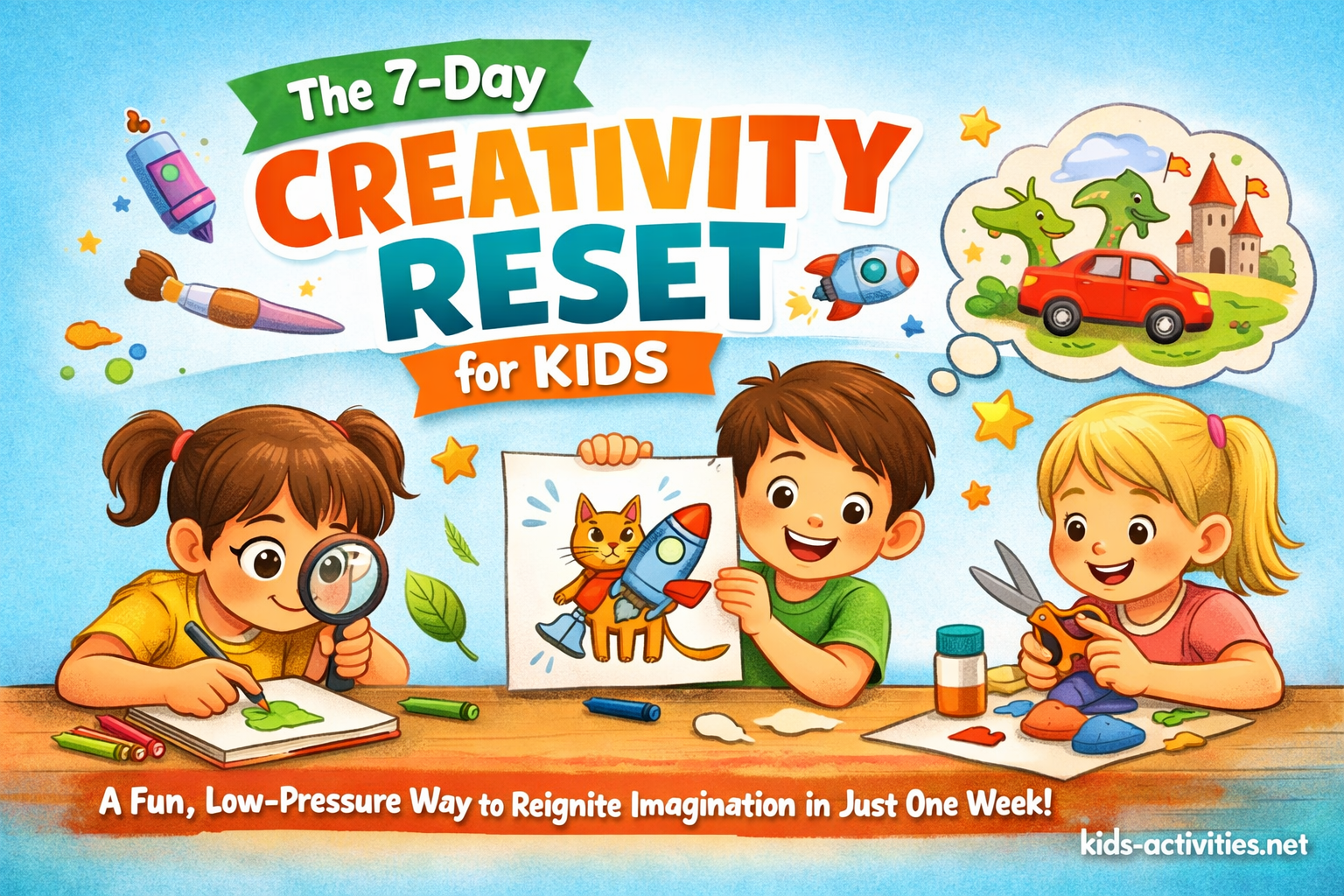
A Low-Pressure, Screen-Aware Way to Reignite Creativity at Home and School
Category: Kids World
Sub-category: Creative Thinking / Learning Habits
Age Range: 4–12
Includes: Free Printable 7-Day Creativity Reset Kit
Why Most Creativity Plans Fail (and Why This One Doesn’t)
Many parents want their children to be creative.
They buy art supplies, save activity ideas, bookmark tutorials — and yet, after a few days, everything quietly stops.
Not because parents don’t care.
Not because kids aren’t creative.
But because most creativity plans ask for too much consistency.
- Too many days
- Too many materials
- Too much preparation
- Too much pressure
What families actually need is not another long challenge — but a creative reset.
This guide introduces a 7-Day Creativity Reset:
a short, flexible framework designed to restart creativity without requiring long-term commitment.
It’s not about discipline.
It’s about momentum.
What Is a Creativity Reset?
A creativity reset is a short, intentional period where children reconnect with:
- Observing the world
- Changing ideas
- Expressing thoughts
After the reset, families can:
- Stop
- Repeat later
- Or move on naturally
There is no failure, no falling behind, and no pressure to continue.
This makes it especially suitable for:
- Busy families
- Children with short attention spans
- Homes with regular screen use
- Classrooms with limited time
Why 7 Days Is the Sweet Spot
Seven days works because it feels:
- Finite
- Manageable
- Easy to start
Psychologically, “one week” feels doable.
Parents don’t need to ask, “Can we keep this up?”
They only ask, “Can we try this for a week?”
That difference matters.
The Core Framework (Used Every Day)
Every day of the reset follows the same simple structure.
Only the prompt changes.
Step 1: Notice (2–3 minutes)
Children observe one thing.
This can come from:
- A YouTube video
- A picture book
- An object at home
- Nature outside
- A sound or movement
The key rule:
One input only. No scrolling.
Step 2: Change (10–15 minutes)
Children change what they noticed.
They do not copy.
They transform.
Examples:
- Change the colors
- Change the shape
- Change the size
- Change the ending
- Combine with something else
This step builds creative thinking far more than copying ever could.
Step 3: Share (1 minute)
Children share one sentence.
Examples:
- “I changed…”
- “I noticed…”
- “Next time I want to…”
Sharing can be with:
- A parent
- A sibling
- A classmate
- Or simply written down
Reflection turns action into learning.
The 7-Day Creativity Reset (Day-by-Day)
Each day focuses on one creative lens.
No extra preparation is required.
Day 1: Notice Like an Artist
Goal: Learn to observe details
Prompt ideas:
- Look closely at a leaf, shoe, toy, or face
- Watch a short video and notice one detail others might miss
Create:
Draw or describe the object focusing on:
- Lines
- Textures
- Small details
Why it matters:
Observation is the foundation of all creativity.
Day 2: Change the Colors
Goal: Break realism
Prompt ideas:
- What if the sky was green?
- What if animals had unexpected colors?
Create:
Re-color a familiar object using “wrong” colors.
Why it matters:
Children learn that creativity allows freedom, not correctness.
Day 3: Change the Shape
Goal: Explore form
Prompt ideas:
- Stretch, flatten, twist, or exaggerate
- Turn circles into creatures
- Make tall things short
Create:
Transform a real object into a new shape.
Why it matters:
This strengthens imagination and spatial thinking.
Day 4: Mix Two Ideas
Goal: Practice creative combination
Prompt ideas:
- Animal + vehicle
- House + tree
- Robot + food
Create:
Combine two unrelated ideas into one creation.
Why it matters:
Most original ideas come from unexpected combinations.
Day 5: Add a Story
Goal: Connect visuals with language
Prompt ideas:
- Who is this character?
- What happened before?
- What happens next?
Create:
Add one sentence or short story to an artwork.
Why it matters:
Storytelling deepens meaning and emotional connection.
Day 6: Choose & Improve
Goal: Learn reflection and revision
Prompt ideas:
- Choose one artwork from the week
- Ask: “What could I change or add?”
Create:
Make a small improvement — not a redo.
Why it matters:
Children learn that creativity is a process, not a one-time result.
Day 7: Share & Celebrate
Goal: Build confidence
Ideas:
- Display the week’s favorite piece
- Let the child explain it
- Take a photo
No critique.
No fixing.
Why it matters:
Celebration reinforces motivation without pressure.
How Screens Fit In (Without Guilt or Power Struggles)
Screens are allowed — but reframed.
In the Creativity Reset:
- Screens are used only in the Notice step
- One video or image at a time
- Screen turns off before creating
This removes:
- Endless watching
- Negotiation battles
- Guilt around screen use
Screens become creative triggers, not distractions.
What Parents and Teachers Actually Do
Your role is intentionally small.
You:
- Set the daily window
- Read the prompt
- Ask one question
You do not:
- Correct artwork
- Add details
- Decide outcomes
Less control leads to more ownership.
Common Concerns (and Honest Answers)
“What if we miss a day?”
Skip it. Continue or stop. No catching up.
“What if my child loses interest?”
That’s okay. The reset already did its job.
“What if the artwork looks messy?”
Messy is often where learning lives.
7-Day Creativity Reset Kit
To support this guide, we created a lightweight printable kit.
Available at:
Free Resource Library → Kids World → Creative Thinking
Includes:
- One-page 7-Day Overview
- Daily Prompt Cards
- Transformation Prompt Sheet
- One-Line Reflection Page
- Celebration & Sharing Sheet
All resources are:
- Printer-friendly
- Reusable
- Suitable for home or classroom
How to Use This Again (Without Burnout)
The key is not repeating immediately.
Ideas:
- Wait a month
- Change the theme (nature, space, emotions)
- Switch materials (clay, collage, digital art)
Each reset feels fresh.
Why This Approach Is Different
Most kids creativity content focuses on:
- Output
- Products
- Final results
The Creativity Reset focuses on:
- Thinking
- Changing
- Reflecting
That’s why it works across ages, settings, and skill levels.
Final Thought
Creativity doesn’t disappear when children stop creating.
It disappears when:
- Everything feels like work
- Expectations feel heavy
- Activities feel endless
A short reset brings creativity back without pressure.
Sometimes, one week is all it takes.
Related Resources
Explore more hands-on, creative activities from kids-activities.net:
- Kids Art Gallery Wall Ideas
- Turning Screen Time into Creative Time
- DIY Volcano Science Lab
- Free Reflection Cards for Kids