

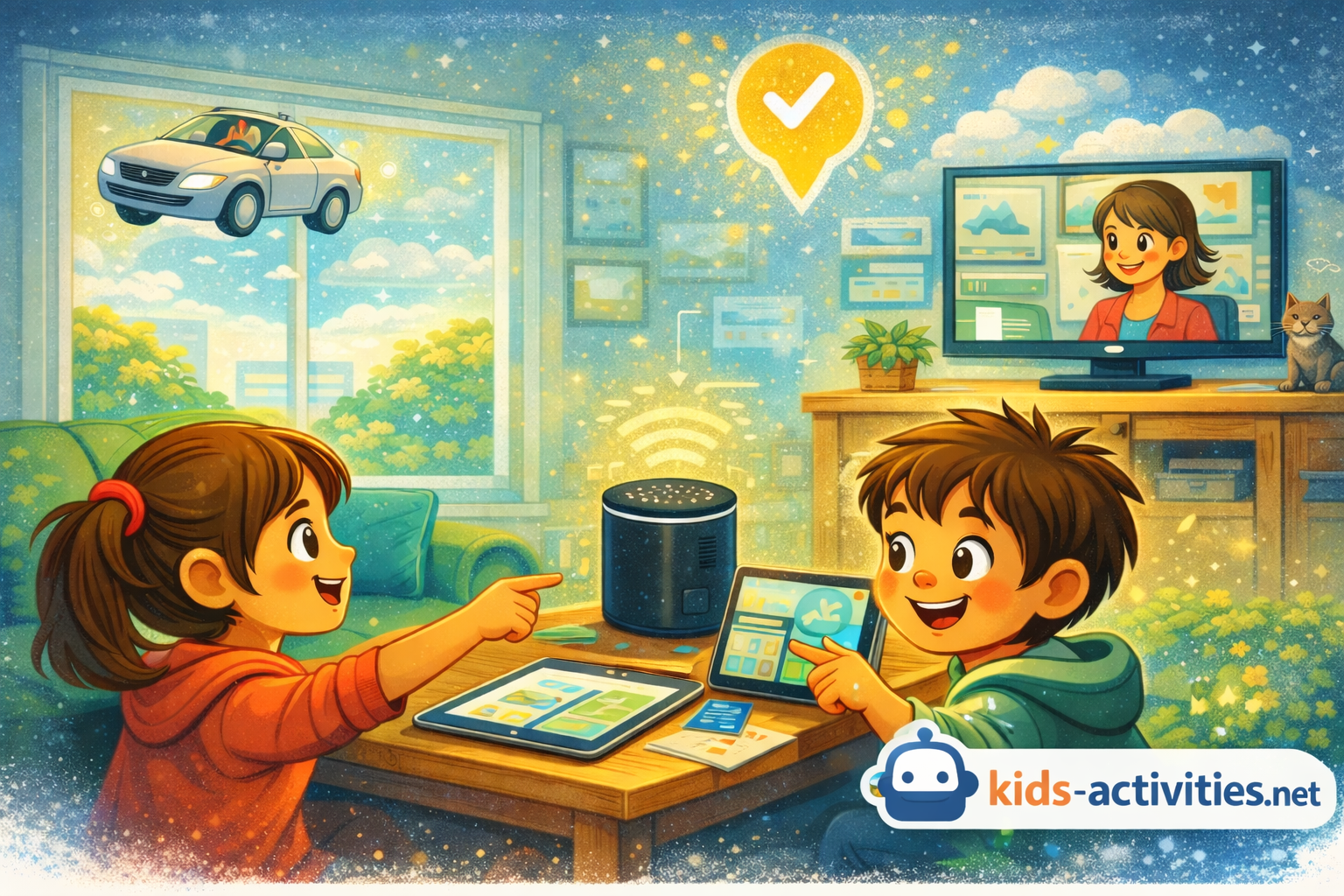
AI Science Activities for Kids (Easy & Fun!)
Artificial Intelligence (AI) is no longer a mysterious technology reserved for scientists working in labs. Today, it lives quietly inside our homes, our schools, and our everyday devices—from smart speakers that answer questions to apps that translate languages instantly. For kids who love science, AI offers a brand-new frontier to explore, experiment, and wonder: How do machines learn? Can computers recognize my drawings? How does a robot follow instructions?
In this blog, we’ll explore fun and safe activities that transform AI into hands-on science for curious young minds. These experiments require little more than household materials, kid-friendly websites, and time spent exploring together. By the end, children will not only understand what AI is, but also feel empowered to invent with it.
What Is AI, Really? (Explaining to Kids Without Boring Them)
Before jumping into experiments, let’s set the stage with a kid-friendly explanation:
AI is a type of technology that learns from information and makes smart decisions—almost like teaching a pet new tricks, but for a computer!
You give AI:
- Examples
- Patterns
- Data
And it starts recognizing:
- Faces in photos
- Objects in the room
- Words you say
- Languages you read
- Directions you travel
Here’s an analogy kids love:
If your brain helps you learn from homework, AI learns from data.
AI doesn’t “think” like humans, but it does detect patterns incredibly fast, which makes it great for science challenges.
Experiment 1: “Teach the Machine to Recognize Doodles!”
Age Range: 6–14
Skills: Machine learning, pattern recognition, curiosity
Materials: Just a laptop, tablet, or phone
Website to Use: Quickdraw (Google AI)
This experiment is simple, addictive, and perfect for beginners.
How it works:
- Visit the doodling website
- The child receives a word (e.g., “cat,” “bridge,” “bee”)
- They draw it quickly on the screen
- AI tries to guess what they drew
- Sometimes it guesses correctly—sometimes not!
What kids learn:
- AI learns from millions of drawings from other people
- The machine recognizes shapes and patterns
- Mistakes are part of training AI (just like learning math!)
Conversation prompts:
- “How fast did the AI guess?”
- “What shapes helped the AI recognize your drawing?”
- “Why do you think the AI got confused?”
STEM connection:
This experiment demonstrates supervised learning—AI learns from labeled examples.
Experiment 2: “Voice Assistant Science Lab”
Age Range: 5–12
Skills: Speech recognition, question design, hypothesis testing
Materials: A smart assistant (Alexa, Google Assistant, or Siri)
Step-by-step:
- Children form “science questions”
- They ask the smart assistant
- They compare responses to predictions
Examples:
- “What happens when you mix vinegar and baking soda?”
- “Why is the sky blue?”
- “Do animals dream?”
- “What is the fastest planet?”
Hypothesis twist:
Before asking, have the child predict what the assistant will say—just like a real science experiment!
What kids learn:
- AI recognizes speech
- Converts sound into words
- Searches databases for answers
- Responds logically (most of the time!)
Science connection:
Speech recognition uses models trained on human speech patterns—this links computer science to biology and language.
Experiment 3: “Create Your Own AI Classifier!”
Age Range: 8–14
Skills: Data labeling, model training, testing results
Materials: Device with webcam
Website to Use: Teachable Machine (browser-based ML tool)
This is hands-down one of the most powerful kid-friendly AI experiments.
What to do:
- Choose a model type (images, sound, or poses)
- Create class categories (e.g., “rock,” “paper,” “scissors”)
- Capture data samples using webcam
- Train the model
- Test it live!
Kids can classify:
- Objects (cup vs. book)
- Hand signs (thumbs up vs. thumbs down)
- Sounds (clap vs. whistle)
- Poses (jump vs. sit)
Discussion prompts:
- “Did the machine make mistakes?”
- “How many samples did it need?”
- “Would more training help accuracy?”
STEM connections:
This activity introduces kids to:
- Computer vision
- Supervised learning
- Data collection
- Model accuracy
Experiment 4: “AI-Powered Language Decoder!”
Age Range: 7–14
Skills: Translation, linguistics, world culture
Materials: Translation app or web tool
Instructions:
- Kids choose phrases in English
- Translate them into another language
- Reverse-translate to check meaning
- Observe changes!
Example:
- English → Spanish → English
- “The cat sits on the chair”
→ “El gato se sienta en la silla”
→ “The cat sits on the chair” (Success!)
But sometimes:
- “Cool” → “Frío” → “Cold” (Oops!)
What kids learn:
- AI doesn’t translate words—it translates meaning
- Some words don’t exist in other cultures
- Grammar rules vary globally
Cultural twist:
Kids can map languages to country flags to build global awareness.
Experiment 5: “Robot Navigation Mission!”
Age Range: 6–12
Skills: Logic, algorithms, spatial thinking
Materials: Toy robot (Bee-Bot, Sphero, Lego robot, or even a drawing)
Goal: Teach a robot to complete a challenge
Possible missions:
- Reach the “volcano”
- Deliver pizza to a “house”
- Avoid the “lava floor”
- Follow a treasure map
If no robot available:
Draw a grid on paper and use a paper robot cutout.
Commands:
- Move forward
- Turn left
- Turn right
- Pick up / drop object
AI concept introduced:
- Algorithm: “A list of instructions”
- Prediction: “If I code this, what will happen?”
STEM connections:
This builds computational thinking—the foundation of AI programming.
How Parents & Teachers Can Support AI Learning
Here are key strategies to foster a healthy AI relationship:
Encourage Curiosity, Not Just Correctness
AI makes mistakes; that’s part of learning.
Explain That AI Isn’t Magic
It’s not a brain—it’s math and data.
Emphasize Creativity
AI empowers kids to invent, not just consume.
Connect AI to Everyday Life
Examples kids understand:
- Maps predicting traffic
- Streaming apps suggesting shows
- Photo apps detecting faces
- Video games using smart characters
Encourage Ethics Discussions
Simple questions like:
- “Should AI copy someone’s art?”
- “Where should we use robots?”
- “How can we use technology responsibly?”
These build future citizens, not just tech users.
What Kids Really Gain From AI Experiments
Through these experiments, kids build:
Scientific Thinking
- Asking questions
- Forming hypotheses
- Testing results
- Observing patterns
✔ Computer Science Foundations
- Data labeling
- Model training
- Algorithms
- Logic
STEM Confidence
AI feels less intimidating and more like a tool they can control.
Creativity
AI becomes a partner for invention, not a replacement for imagination.
Ethical Awareness
They learn responsible use of technology early.
Bonus: DIY Home AI Activity List
Quick activities for later:
Recognize animal sounds using apps
Identify plants using phone AI
Navigate walks using map predictions
Translate lunch menu words
Talk to a voice assistant in different accents
Generate AI art based on kids’ sketches
Study how NPCs behave in video games
Kids love these, and they organically teach AI principles.
Conclusion: AI Isn’t the Future—Kids Are
AI is a powerful tool, but its true magic lies in what kids do with it. When children experiment with AI, they’re not just learning technology—they’re learning curiosity, creativity, and problem-solving. They become explorers of patterns, inventors of ideas, and scientists of play.
The best part? You don’t need expensive tools or complicated software. With simple experiments, AI becomes something kids can see, touch, and shape. And who knows—maybe in 15 years, today’s doodling child will become tomorrow’s AI scientist, robotics engineer, or digital artist.
Technology changes fast, but curiosity never goes out of style.

Recent Posts
Family Podcast Project for Kids: A Fun Educational Activity That Builds Confidence
Build a Marble Roller Coaster: A Hands-On STEM Challenge for Kids